
Written Scope First
Know what is included, excluded, priced, and expected before records are transferred.
How Medical Record Review Works
We begin with the decision you need to make. Before any records are transferred, Critical Timeline™ confirms the appropriate service, written scope, price, timing, boundaries, and next steps.
3–5 minute intake · No medical records or protected health information requestedKnow what is included, excluded, priced, and expected before records are transferred.
Medical records are not accepted through public inquiry or intake forms.
Material findings are connected to the record whenever the selected service includes source citation.
Client-facing work is reviewed for accuracy, clarity, consistency, and scope alignment.
The Critical Timeline Method
A linear method for moving from scattered documentation toward the next responsible conversation or action.
Inventory the available records, identify the sources, structure the information, and reconstruct the documented sequence.
Add the level of explanation or nurse-led clinical context supported by the selected service, while identifying gaps, discrepancies, limitations, and open questions.
Present the information in a form that helps the intended audience prepare for the next responsible conversation or action.
Five client-facing steps
FIND THE RIGHT STARTING POINT
Complete a short, privacy-conscious intake using only non-sensitive information. Tell us who the work is for, the decision you are preparing to make, the approximate record scope, and your timing needs.
We use the information to identify fit and a likely starting service. Do not submit medical records, patient names, dates of birth, diagnoses, or detailed case narratives.
CONFIRM SCOPE
We evaluate intended use, record volume, facilities, date span, specialty, completeness, urgency, and requested deliverable to determine the most appropriate starting point.
You receive a written scope identifying what the engagement includes, what it excludes, the expected price, timing, and required next steps.
COMPLETE ENGAGEMENT
After the scope and engagement terms are accepted, separate record-transfer instructions are provided. Medical records are never requested through the general inquiry or public intake form.
Your public intake describes the work—not the patient.
The approved transfer process and authorized users are confirmed for the specific engagement before files are received.
REVIEW AND VERIFY
Records are inventoried, organized, indexed, sequenced, and reviewed according to the agreed service.
Plain-language organization and practical next questions.
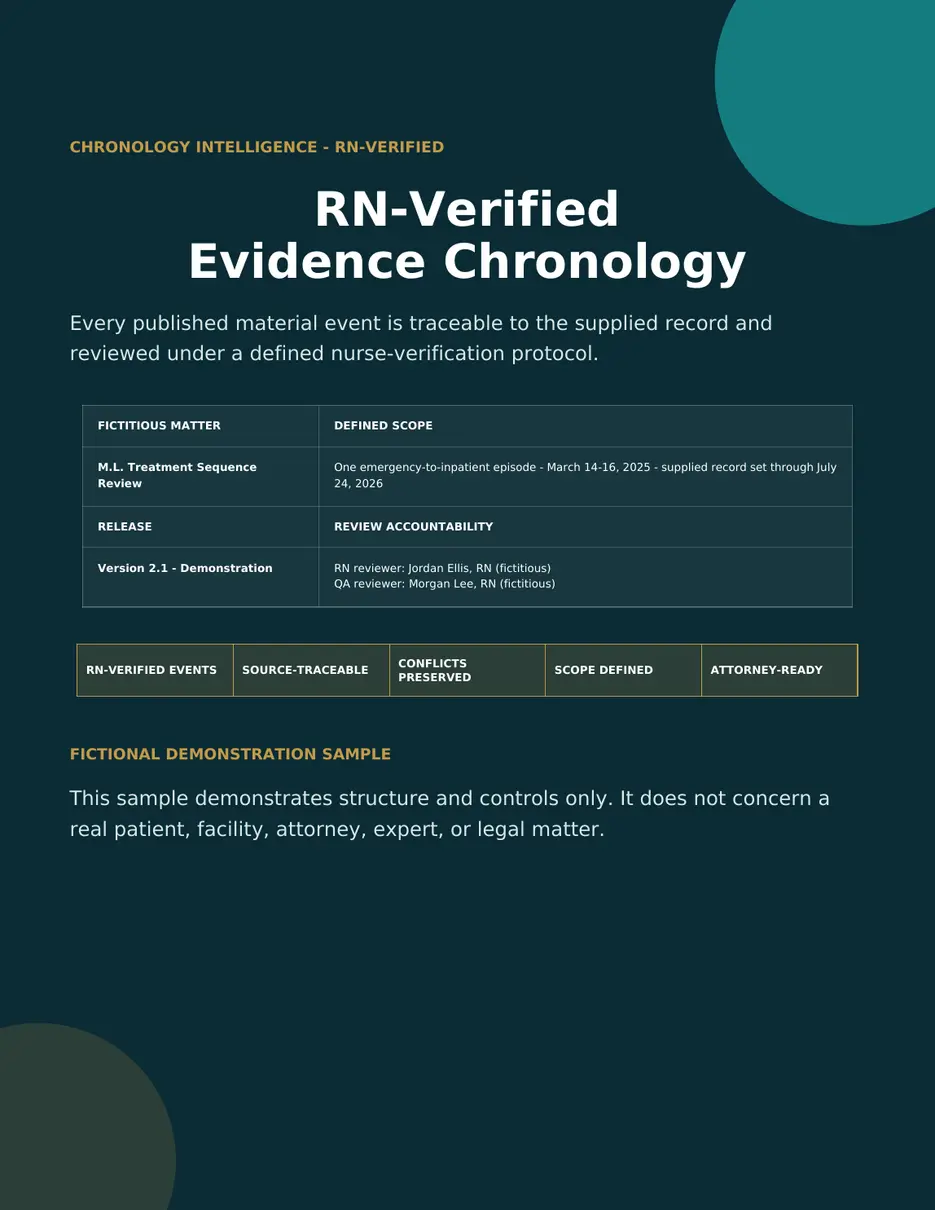
Material-event source verification, conflict preservation, gap review, and a controlled release.
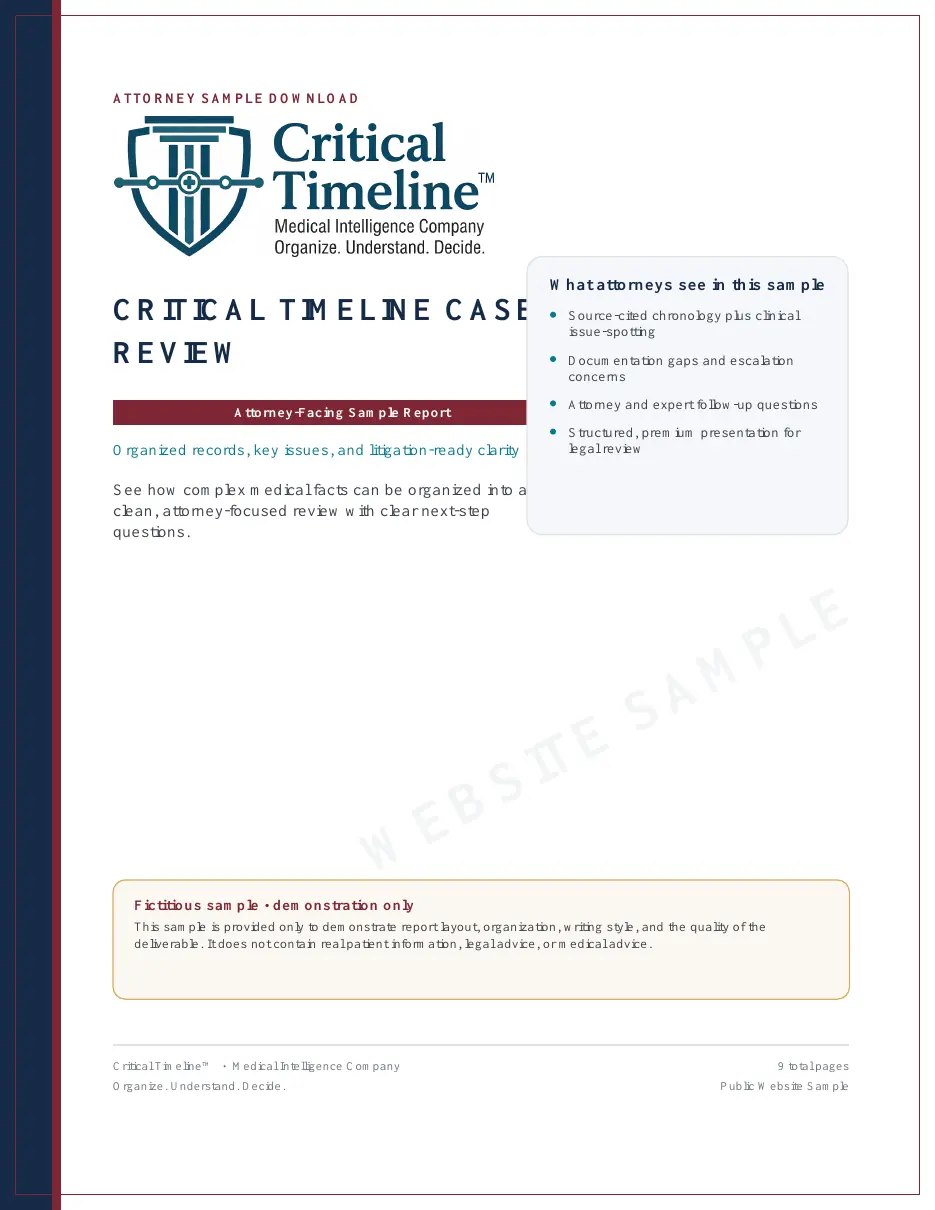
Focused nurse-led identification of preliminary clinical issues and missing information.
Comprehensive chronology plus deeper analysis of clinical concerns, timing, escalation, discrepancies, and expert questions.
Before release, the work is checked for source accuracy, internal consistency, clarity, completeness within scope, and separation of documented fact from analysis.
RECEIVE AND USE THE WORK
The final work is delivered in the format defined by the engagement. Depending on the service and current platform availability, authorized clients may also receive access to a matter workspace for published reports, record gaps, findings, and next actions.

Additional records, updated timelines, deposition preparation, expert coordination, examination support, or ongoing case needs can be scoped separately as the matter evolves.
Defined work products
Every engagement is designed to produce a clearly defined work product matched to the audience and decision.
Accurate scoping
You do not need to understand every service before contacting us. Non-sensitive information is enough to begin.
Realistic expectations
Record count is only one factor. Complexity and the depth of requested review matter too.
Frequently asked questions
No. The public intake is used only to identify fit and likely scope. Separate record-transfer instructions are provided after engagement.
You do not need to select perfectly. The guided intake considers your audience, goal, record scope, completeness, specialty, and timing before recommending a starting point.
No. Critical Timeline organizes and reviews medical information within the defined engagement. It does not independently determine negligence, liability, causation, damages, legal deadlines, or claim value.
Missing or potentially relevant records may be identified within the limits of the selected service. Additional review may be scoped after supplemental records are received.
Platform or workspace access depends on the selected service, engagement terms, and current availability. The final deliverable and access method are confirmed in the written scope.
Start With Fit—Not File Uploads
Complete a short, non-sensitive assessment. We will use your answers to identify the most appropriate service and next step before any records are transferred.
Usually 3–5 minutes · No medical records, diagnoses, or detailed case narrative requested