
EMS handoff records symptom onset and field intervention.Source: EMS Run Report, p. 42
Medical Intelligence for attorneys handling medically complex matters
Turn the Entire Medical RecordInto Attorney-Ready Intelligence.
Critical Timeline organizes, verifies, and clinically contextualizes the relevant medical record as a whole—not just nursing documentation—so counsel can understand the sequence faster and identify what deserves closer attorney or qualified-expert attention.
Source-grounded · RN-accountable · Human-verified · Serving counsel nationwide
Prefer to evaluate the deliverable first? View sample work →!MISSING RECORDOutside imaging report not located
RN-VERIFIED CHRONOLOGY08:42 09:17
Documented Clinical Sequence
Provider assessment, imaging order, and medication plan documented.Source: Physician Note, p. 201
RN verifiedMissing records surfacedKey questions prioritized
Material facts connected to the supplied source record.
A named clinical reviewer remains responsible for defined verification work.
Material events checked for accuracy, attribution, and unresolved concerns.
Structured for efficient counsel and qualified-expert review.
Whole-record medical review
One Medical Record. Many Sources.
We review the medical record as a whole—not just nursing documentation. The RN is the accountable clinical reviewer; the evidence is the relevant source set defined for the engagement.
Clinical Documentation
Physician notes · nursing records · consultations
Diagnostics
Labs · imaging · pathology · monitoring
Treatment
Medication records · procedures · operative reports
Care Transitions
EMS · admissions · transfers · discharge · rehabilitation
We connect information across the supplied record so attorneys can see the documented sequence—not isolated notes viewed in isolation. The exact sources reviewed are confirmed in the written scope.
Beyond a medical record summary
A Summary Condenses the Chart. Medical Intelligence Makes the Record Easier to Use.
Medical records rarely present the case in a clean sequence. Important events may be scattered across providers, facilities, diagnostics, treatment records, orders, flowsheets, and care transitions.
Critical Timeline™ turns the relevant source set into verified, structured, clinically intelligent, attorney-ready information—so counsel can spend less time reconstructing the chart and more time deciding what requires deeper investigation.
Organize
Bring fragmented records, providers, facilities, and episodes into a controlled medical-information structure.
Verify
Check material events against the supplied source and preserve conflicts, ambiguities, and missing-source concerns.
Understand
Reconstruct the sequence, important intervals, documentation gaps, and clinically relevant questions within scope.
Decide
See what deserves closer attorney review, supplemental records, screening, or qualified-expert attention.
The economics of a usable record
Medical-record work has an opportunity cost.
Complex medical-record work does not consume only review time. It can also consume attorney attention, expert time, staff capacity, and case momentum when the record remains difficult to navigate, incompletely sourced, or repeatedly reconstructed.
Attorney reconstruction time
Attorney time is expensive. When the medical record is not structured and source-grounded, attorneys and staff may repeatedly search for the same dates, providers, findings, communications, and treatment events. Critical Timeline is designed to move much of that reconstruction upstream.
Premature expert expense
Experts should analyze—not organize. A qualified expert should not need to spend premium professional time locating basic chronology events, reconstructing record architecture, or determining which records appear to be missing. A source-grounded workflow can prepare the matter before expert investment.
Source uncertainty
A polished chronology is not necessarily a verified chronology. An entry may look authoritative while carrying an incorrect timestamp, provider attribution, incomplete citation, unsupported wording, or unresolved conflict. Critical Timeline separates organization from verification.
Late missing-record discovery
A large production can still be incomplete. EMS records, audit trails, flowsheets, medication-administration records, communication documentation, operative records, imaging, fetal-monitoring material, or transfer documentation may sit outside the obvious chart sequence.
Supplemental-record rework
New records can change an already-built timeline. Source structure, versions, unresolved conflicts, and supplemental-record history help new information be reconciled rather than forcing the legal team to repeatedly rebuild the medical story.
A disciplined order of work
Move expensive attention downstream.
Critical Timeline helps organize and verify the evidence before attorney and expert attention becomes the most expensive part of the workflow.
- Organize the record.
- Verify the material evidence.
- Expose what is missing or conflicting.
- Then decide where deeper attorney and expert attention belongs.
Start free—without records
Find the readiness gap before choosing the service.
The Matter Intelligence Scan™ uses ten categorical questions to show whether source control, sequence, question focus, expert posture, or timing needs attention first. The complete result appears before sign-in.
No uploads · No names · No clinical narrative · No case-merit assessmentORGANIZEControl the source and sequence.UNDERSTANDFocus the review question.DECIDEChoose the next preparation step.
When to engage
Bring Us In Before the Medical Record Becomes the Bottleneck.
Critical Timeline can support counsel at several points in the life of a medically complex matter.
Early Matter Evaluation
Determine whether the available records identify issues that justify additional investigation, supplemental requests, or expert investment.
Before Expert Retention
Organize the sequence, surface missing information, and frame focused questions before higher-cost expert review begins.
During Discovery and Case Development
Integrate supplemental records, clarify conflicting documentation, and prepare the medical story for depositions, mediation, or further investigation.
Before a DME or IME
Prepare for, observe where permitted, or analyze the resulting examination report against the documented record.
When the Case Keeps Growing
Maintain continuity as new records, experts, examinations, and litigation needs are added.
Chronology Intelligence
Use technology for speed. Add RN accountability where the evidence must hold up.
Automated organization, targeted auditing, and full RN verification are three different scopes. Critical Timeline labels them honestly.
Automated Record Map
Starting at $99Technology-assisted inventory and orientation. Not RN verified and not a final attorney-ready chronology.
Explore this pathway →Targeted AI Chronology Audit
Starting at $750Audit selected facts, every designated material event, or the full chronology under a separately defined scope.
Explore this pathway →RN-Verified Evidence Chronology™
Starting at $1,750Up to 250 clean pages for one defined episode or focused sequence, with event-level verification and release controls.
Explore this pathway →Decision-based service progression
Choose the Depth of Medical Intelligence the Decision Requires.
Not every matter requires the same level of review. Start with the decision counsel needs to make, then match the service to that purpose.
ORGANIZE→SCREEN→ANALYZE→EXAMINE→CONTINUE
ORGANIZE
RN-Verified Evidence Chronology™
A source-traceable chronology in which an RN verifies every published material event, corrects inaccuracies, preserves conflicts and ambiguities, and releases the defined sequence with named reviewer accountability.
Best for: A sequence or source trail that is unclear, including an existing AI or vendor chronology that needs an accountable verification layer.
Starting atStarting at $1,750Explore RN-Verified Chronologies
SCREEN
Attorney Case Screening
A focused nurse-led review designed to identify clinically significant issues, timing concerns, discrepancies, documentation gaps, and missing records before counsel commits to a larger review or expert engagement.
Best for: Potential matters with uncertain clinical complexity, including Emergency Department and Labor & Delivery cases.
Starting atStarting at $2,250Explore Case Screening
ANALYZE
Critical Timeline Case Review
A structured, nurse-led review connecting the documented sequence with clinically relevant concerns, escalation points, intervals, documentation gaps, and focused questions for attorney or expert consideration.
Best for: Medically complex matters requiring more than chronology alone.
Starting atStarting at $4,750Explore Case Review
EXAMINE
Medical Examination Intelligence
Structured support before, during, or after a defense or independent medical examination.
Available pathways: Medical Examination Report Analysis™, DME/IME Nurse Observation™, or the combined Medical Examination Intelligence Package™.
Starting atStarting at $1,250Explore Examination Services
CONTINUE
Ongoing Case Intelligence
Continuing support as additional records arrive and the matter progresses through expert review, depositions, examinations, mediation, or trial preparation.
May include: Supplemental record review, literature support, deposition preparation, expert coordination, updated timelines, and visual case materials.
Starting at$2,500 replenishing retainerExplore Ongoing Support
NOT READY TO SCOPE PAID WORK?Use the free toolkit to control the record plan and expert handoff first.
Open Free Attorney ToolsWorks alongside your existing technology
Already Using AI or Legal Case Software? Keep It.
Your case-management system, internal summary, or technology-assisted chronology can remain part of the firm’s workflow. You do not necessarily need to start over.
Automation can organize information. Critical Timeline verifies evidence and adds clinically informed human review. Under a defined scope, we can review the source support, preserve ambiguities and conflicts, identify missing-source concerns, and add specialty-matched nursing judgment with RN accountability.
Discuss a Verification ScopeSee the work before you engage
Review the structure, source discipline, and presentation quality.
These fictional, clearly labeled examples demonstrate report structure, source-citation discipline, analytical boundaries, and attorney-facing presentation.
VERIFY & ORGANIZE
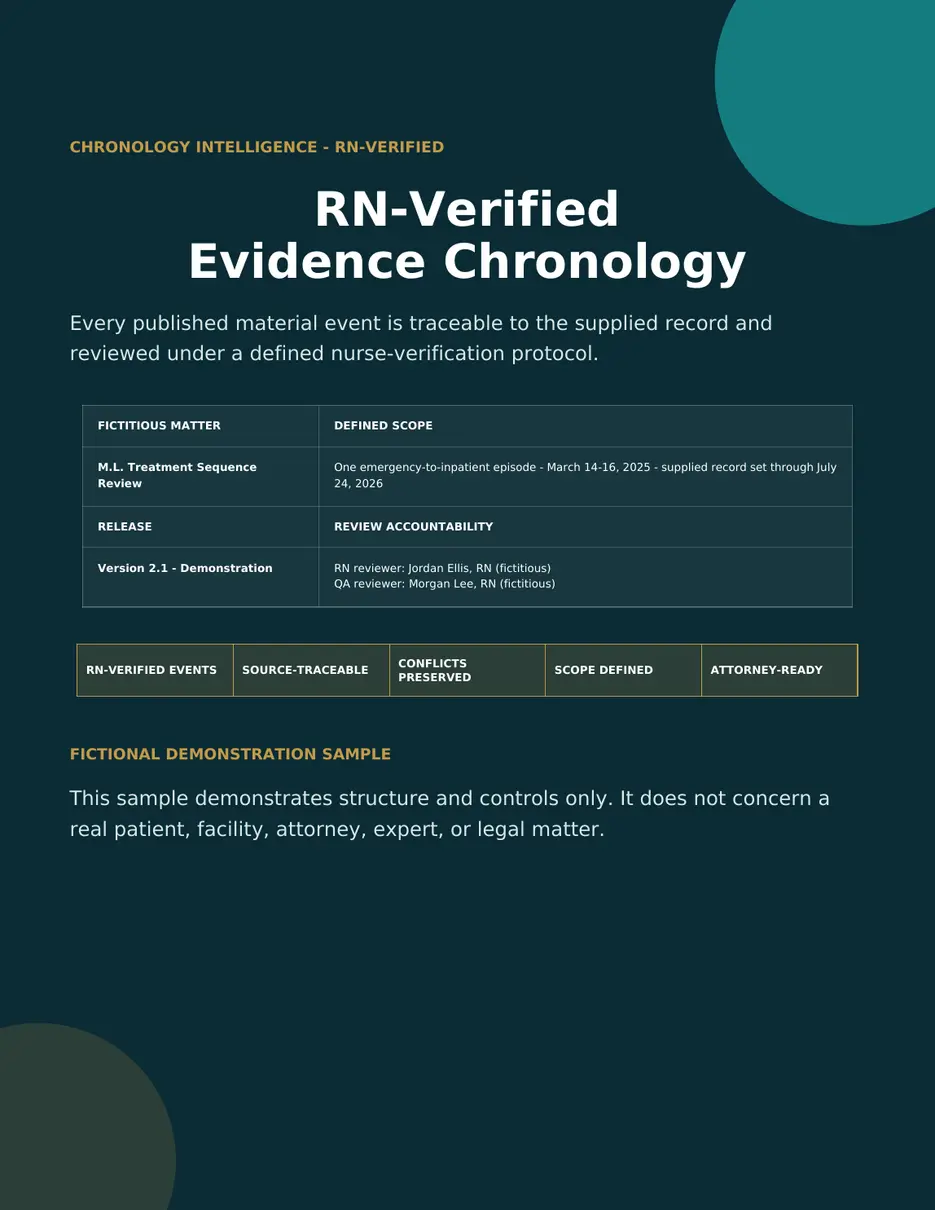
RN-Verified Evidence Chronology
See material-event source verification, conflict handling, missing records, limitations, reviewer identity, and release controls.
View Chronology Sample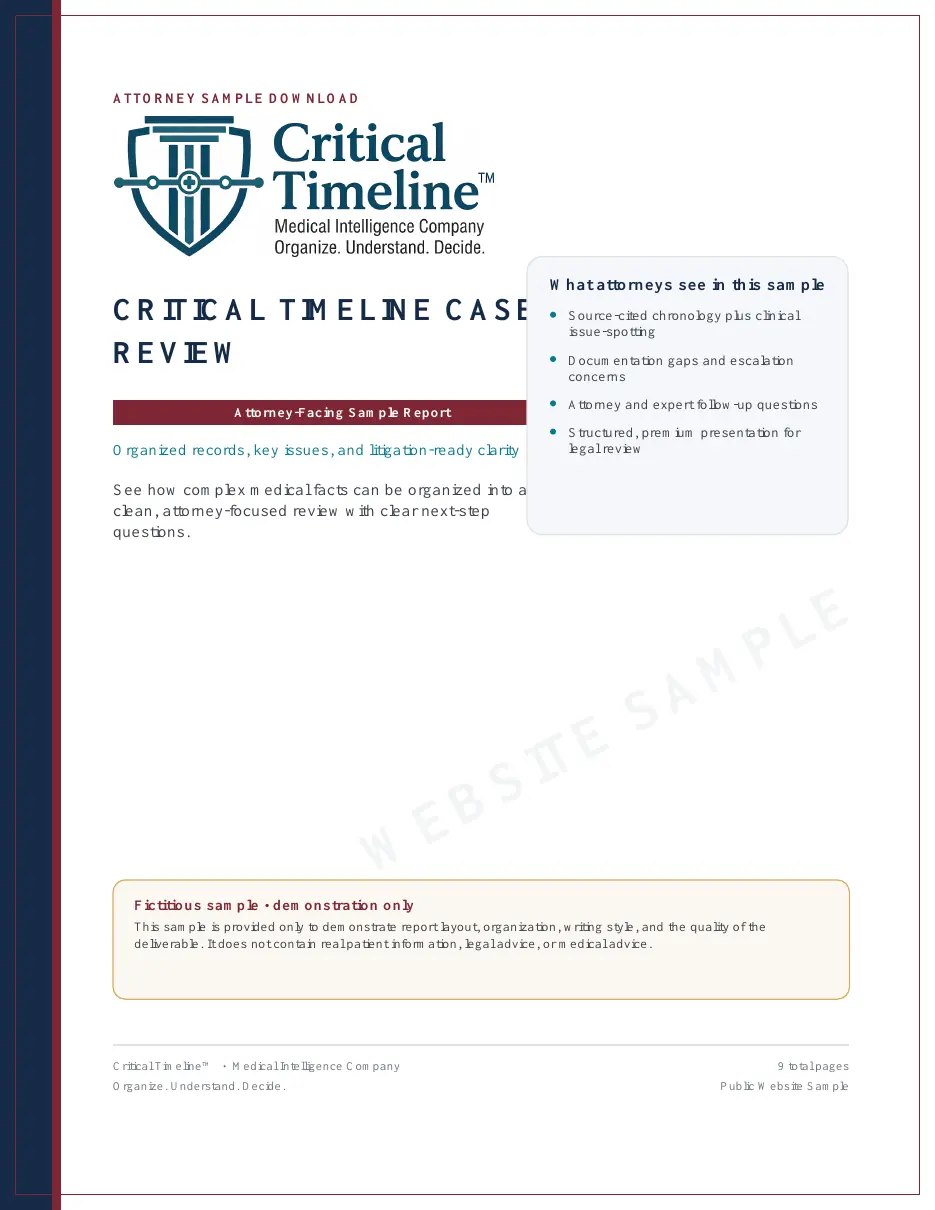
ANALYZE
Critical Timeline Case Review
See how chronology, clinical issue identification, documentation gaps, and follow-up questions are brought together.
View Case Review SampleHonest service boundaries
Automation Organizes. RN Verification Makes the Evidence Accountable.
RN verification strengthens source integrity. It does not turn a chronology into a clinical screening.
| Capability | Automated Record Map or AI Chronology | RN-Verified Evidence Chronology | Attorney Case Screening |
|---|---|---|---|
| Document organization | Yes | Yes | Yes, within the focused scope |
| RN verification of published material events | No | Yes | Yes, for scoped evidence used in the screen |
| Source and page traceability | Generated; not necessarily RN checked | RN checked for published material events | RN checked for findings used in the screen |
| Ambiguity & Conflict Register | Automated flags may be generated | RN reviewed and preserved | RN reviewed with focused clinical significance |
| Preliminary clinical issue identification | No | No formal clinical screening | Yes, within the written scope |
| Recommendation about deeper investigation | No | No | Yes—obtain records, defer, deepen review, or consider expert consultation |
Source Traceability
Material findings are connected to defined record sources whenever the engagement permits.
Clinical Discipline
Facts, clinical observations, limitations, and questions are kept visibly separate.
Defined RN Verification
For the chronology service, an RN checks each material event's date, time, attribution, description, and source location before publication.
Decision-Focused Scope
Each engagement begins with the decision, conversation, or case need counsel is preparing for—not a generic promise to summarize pages.
Expert-Ready Handoff
Organized records and focused questions help qualified experts begin substantive review sooner.
The Critical Timeline Standard
Five commitments behind every appropriately scoped engagement.
These are operating requirements—not decorative trust badges.
Every material finding is traceable
We connect material findings to a defined record source whenever the engagement permits.
Facts remain separate from observations
Documented facts, clinical observations, limitations, and questions are labeled instead of blended.
Missing information is made visible
Expected-but-not-located records, unresolved discrepancies, and scope limits are clearly identified.
A named RN remains accountable
For an RN-Verified Evidence Chronology, the protocol, reviewer identity, verification date, conflicts, and limitations travel with the release.
Scope is defined before work begins
Purpose, deliverables, boundaries, timing, and pricing are confirmed before records are reviewed.
Attorney questions, answered
What Critical Timeline adds—and where the boundaries remain.
Clear scope language helps counsel choose the right service without mistaking Medical Intelligence for commodity summarization, software replacement, or expert opinion.
View all frequently asked questionsDo you only review nursing notes?
No. The RN is the clinical reviewer; the relevant medical record is the evidence being reviewed. Depending on the agreed scope, that may include physician documentation, nursing records, EMS records, medication records, labs, imaging, operative reports, hospital and specialty records, and other supplied medical documentation.
My firm already uses AI or case-management software. Why would I need Critical Timeline?
Keep using it. Technology can efficiently organize records and draft chronologies. Critical Timeline can work from the source records or, under a defined scope, review existing technology-assisted work to add source verification, conflict and ambiguity review, clinical context, and accountable RN review. No software integration or partnership is required or implied.
Is Critical Timeline replacing the medical expert?
No. Critical Timeline organizes and clarifies medical evidence, identifies questions, and prepares the matter for more efficient attorney and qualified-expert review. Opinions on negligence, causation, liability, standard of care, damages, case value, or legal merit remain outside our role unless provided by the appropriately qualified retained professional.
Is this just medical-record summarization?
No. A summary condenses the chart. Depending on the selected service, Medical Intelligence may combine structured chronology, source traceability, RN verification, missing-record identification, conflict and ambiguity preservation, clinical-context recognition, and focused questions for further attorney or expert review.
Signature deliverable component
The Decision Intelligence Brief
Where appropriate to the selected service, the final work includes a concise decision layer so counsel does not have to reconstruct the conclusion from a long chronology.
It does not decide negligence, causation, liability, or case value. It organizes the record around the next responsible attorney or expert decision.
See sample workWhat the record establishes
The documented sequence and material facts supported by identified sources.
What remains unclear
Conflicts, ambiguous documentation, and questions the available record does not resolve.
What is missing
Expected records, attachments, audit sources, or supplemental material not located.
What deserves attention next
Prioritized follow-up questions, record requests, or expert preparation needs.
After delivery
The medical story remains usable as the matter changes.
A report can be final for its defined scope without becoming a dead end. Authorized continuing work can keep the record, findings, gaps, and next actions connected.
Incorporate new records
Add supplemental productions without losing the prior source structure.
Update missing-record status
Show what arrived, what remains outstanding, and what changed.
Preserve source links
Keep material findings connected to the supporting record as updates are reviewed.
Track questions and actions
Carry focused questions, owners, deadlines, and next steps into the following phase.
The differentiator:you are not simply buying a document. You are building a controlled medical-information foundation that can continue with the matter.See how the workspace works →
Medical Intelligence Platform
One Matter Workspace. Fewer Disconnected Handoffs.
Authorized legal teams can review published reports, trace findings to source materials, monitor missing records, assign next actions, and follow matter activity from one organized workspace.
The platform complements—not replaces—attorney-ready reports. It keeps the report, supporting intelligence, record gaps, communications, and next steps connected as the matter evolves.
Compare Free Toolkit, Project Service, and Firm Intelligence →Firm Intelligence
One continuing relationship for recurring medically complex matters.
A Firm Intelligence Account supports service funding, matter continuity, standardized preferences, workspace access, and recurring medical-intelligence workflow without promising unlimited labor or immediate case starts.
 FOUNDER · REGISTERED NURSE
Clinical experience · Structured method · Accountable review
Trust the people—and the process—behind the work.
Critical Timeline™ combines more than 24 years of emergency nursing experience, standardized review methods, source-traceable reporting, and defined quality controls. Reviewers are assigned according to the clinical issues and scope of the matter, and all final client-facing work is subject to human review.
RN-led reviewSpecialty reviewer availabilityNationwide remote serviceApproved record-transfer process
Review our reviewer standards Free Attorney Tools
Move from a static checklist to a connected readiness workflow.
Use each tool on its own, or save the results under one anonymous matter code after sign-in.
Matter Intelligence Scan™
Assess Organize, Understand, and Decide readiness in 3–5 minutes.
Start the free scan →Record Request Builder™
Generate a categorical source-control plan with editable request and receipt status.
Build a request plan →Matter Readiness Workspace™
Save one anonymous matter, connected tool results, tasks, and owner exports.
Open the free workspace →Expert Spend Gate™
Test source, sequence, question, specialty, and timing readiness before expert spend.
Run the Expert Spend Gate →Downloadable desk references
Keep the original PDF checklists nearby.
The PDF resources remain available for quick reference and offline use.
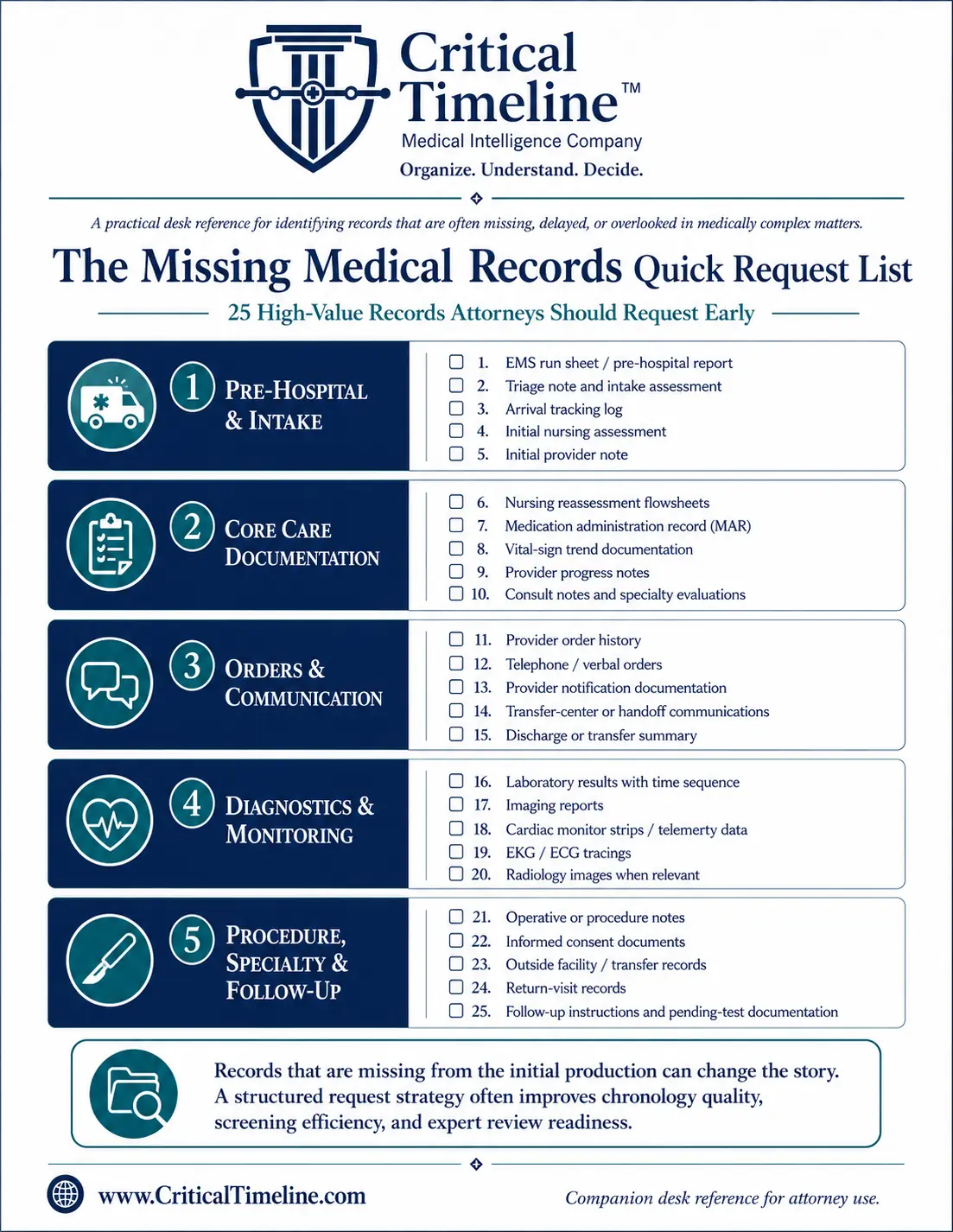
25 high-value records
Missing Medical Records Quick Request List
A desk reference for records that are often delayed, overlooked, or missing from the initial production.
Download the PDF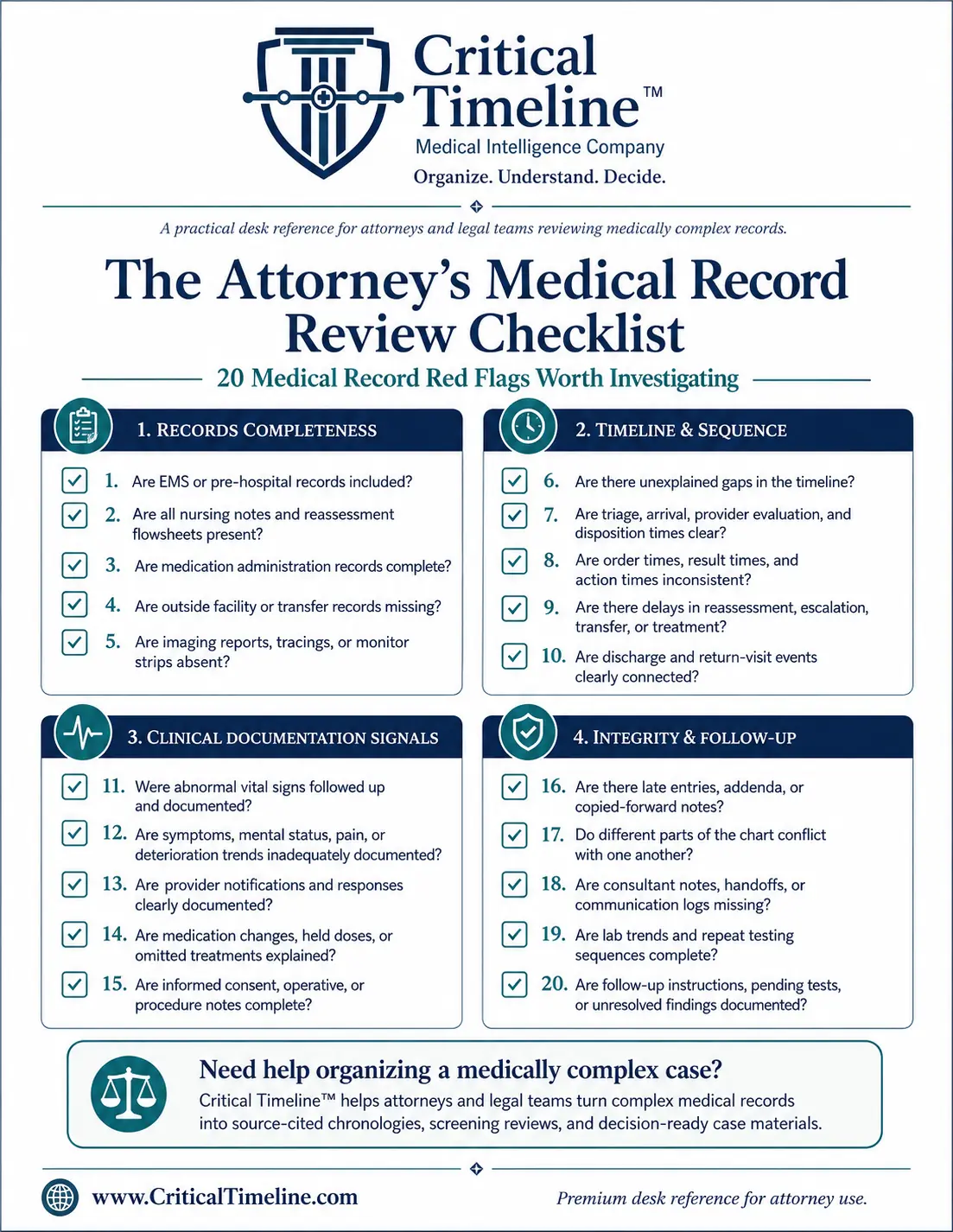
20 red flags worth investigating
Attorney’s Medical Record Review Checklist
A quick review aid for completeness, sequence, clinical documentation signals, integrity, and follow-up.
Download the PDFSpecialty and matter pathways
Route the record to the clinical focus the matter requires.
The core services remain consistent; these focused pages explain the source architecture, specialty boundaries, and next-step questions for common matter types.
Sacramento-based · Nationwide service
Based in Sacramento. Supporting Legal Teams Nationwide.
Critical Timeline™ provides remote-ready legal nurse consulting and Medical Intelligence services to attorneys throughout California and across the United States. Our Sacramento location supports legal teams in Northern California, including the San Francisco Bay Area, without limiting engagements to a particular region.
Confidential scope conversation
Have a Medically Complex Matter?
Start with a confidential scope conversation. We will confirm the decision you are preparing for, whether the matter fits our services, the appropriate level of review, expected timing, record-transfer process, and starting scope before work begins.
Do not send medical records through the general inquiry form. Secure transfer instructions are provided after fit and engagement are confirmed.